The health of democracy, indeed government generally, often rests more with the quality of a country's civil servants than with the quality of its politicians and their associates. Rarely have we seen as graphic a contrast between the two as we are seeing at the Trump impeachment hearings. On the one hand, we have seen a series of witnesses illustrating the very best in American government, indeed in American society. On the other hand, we have Trump's rabble of enablers and associates.
For example, among the witnesses we have Marie Yovanovitch, former ambassador to the Ukraine, who courageously defied the administration by responding to a subpoena from Congress in order to testify. Her testimony included comments that Trump and his allies’ actions may have encouraged corruption in Ukraine rather than help curb it. Ms. Yovanovitch has given 33 years of sterling service to her country for which she was rewarded with a smear attempt by Trump and his allies.
Then there is Lt. Col. Alexander Vindman, the White House's top Ukraine expert, who expressed concerns about President Donald Trump's phone call with the Ukraine President to the National Security Council. He testified that it was "completely apparent" that to get a meeting with Trump, the Ukrainian president had to deliver an investigation of Biden's son. Vindman, who was awarded a Purple Heart for his service in Iraq and still carries shrapnel in his body, is currently Director for European Affairs with the National Security Council.
Fiona Hill, a Russian expert, made a particularly powerful witness. Her testimony dismissed the suggestion that it was Ukraine that interfered in the 2016 U.S. election as a "fictional narrative," emphasizing that it was the Russians who "systematically attacked our democratic institutions" and who perpetrated the Ukraine narrative. Hill served as an intelligence analyst under Presidents George W. Bush and Barack Obama, and as Deputy Assistant to the President and Senior Director for European and Russian Affairs on the National Security Council until she resigned in July.
And there were others, such as such as William B. Taylor, Jr., a
decorated Vietnam veteran and top U.S. diplomat in Ukraine, who
testified that the president of the United States pressured the
president of Ukraine to sully the reputation of a political rival,
Joe Biden, in exchange for a meeting in the Oval Office and a release of
defense funds already approved by Congress. The integrity and dignity of
these witnesses shone in bright contrast to the shenanigans of
the wretched characters that Trump surrounds himself with, a number of whom are now in jail with more on their way.
The American civil service will require extensive repair after Trump and his minions are through with it. Nonetheless, if there is hope for America through these times of dimmed democracy, it lies largely with the integrity and ability of dedicated civil servants, specifically the integrity and ability of people such as Yovanovitch, Vindman and Hill.
Incidentally, all three are immigrants.
Friday, 29 November 2019
Wednesday, 27 November 2019
Hong Kong Has Spoken
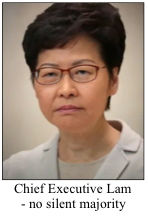
Hong Kong has spoken, indeed has shouted, and it has shouted "democracy" loud and clear. Pro-democracy candidates secured almost 90 percent of district council seats in Sunday's election, taking control of 17 out of 18 councils, a staggering defeat for the Chinese government and pro-Beijing Chief Executive Carrie Lam. The councils have little power and therefore usually attract little interest, but this election experienced a record turnout, 71 percent, obviously to make a statement. Ms. Lam had said, despite months of demonstrations against her government, that she had the support of a silent majority. On Sunday the majority begged to differ. The unpopular Lam acknowledged that among the issues voters wanted to express their views on included "deficiencies in governance."
"This is a democratic tsunami," said Tommy Cheung, a former student protest leader who won a seat himself. The tsunami is a challenge to Xi Jinping, but he is unlikely to make concessions, and indeed his minion, Lam, has made no concessions. China. after all, needs to send a message to Xinjiang and Taiwan. Beijing predictably blames foreign forces for the protests.
Regardless of what happens next, this display of democratic fervour is deeply refreshing at a time when authoritarianism, nationalism and isolationism are on the rise, and the liberal world order is being tested. The over 70 percent turnout, even though exceptional, was particularly impressive. Our municipal elections commonly get turnouts of closer to 40 percent even though our municipal councils have substantial power. We could use a little of that Hong Kong passion.
Monday, 25 November 2019
Evangelicals and Their Populist Prophets
Christian evangelicals are having good innings in the political sphere these days. First, their man Donald Trump becomes president of the U.S.; then another of their populist heroes, Jair Bolsonaro, becomes president of Brazil; and now Bible-toting evangelical Jeanine Anez has assumed the presidency of Bolivia. Hallelujahs all around.
Curiously, for an ostensibly moral bunch, they seem to have a fatal attraction to bad boys. President Trump, for example, is a misogynistic, racist, lying narcissist without even a distant relationship with common decency. Yet evangelicals love him. Or at least white evangelicals do. He captured 80 per cent of their vote in the 2016 election.
And if Trump is bad, Bolsonaro is outright evil. This homophobic, racist misogynist once called for the assassination of a former president; argued that torture is a legitimate practice; told a fellow female legislator that he wouldn’t rape her because she was ugly; and said he would rather have his son die in an accident than come out as a homosexual. He has referred to the military dictatorship of 1964-1985 as a "glorious" period but faults it for "the error ... that it tortured, but did not kill." Like Trump a climate change denier, he wants to deforest and develop the Amazon. A former military superior once reported he was "lacking logic, rationality and balance.” But a lack of rationality and balance doesn't bother evangelicals. Without their support he wouldn't have become president. Needless to say, he is a fan of Donald Trump.
And most recently, we have right-wing senator Jeanine Anez replacing Evo Morales as president of Bolivia. Although her credentials are more respectable than those of Trump and Bolsonaro, they include a fair measure of bigotry. She has made derogatory statements about the country’s indigenous people, who make up 60 percent of the population, tweeting on one occasion, “I dream of a Bolivia free of Indigenous satanic rites. The city is not for Indians, they should go back to the mountains or the fields.”
What attracts the white religious right to these barbarians is certain common beliefs, particularly around gender, including opposition to abortion and gay rights. They see these leaders as divinely appointed and themselves as the true believers. They tend to view the world in the same fundamentalist way—black/white, good/evil, us/them. Evangelism is a brittle faith, overcome by the challenge of multiple perspectives.
I have often wondered if it isn't this cohort of Americans that explain why the U.S. is among the least compassionate and most vindictive of Western nations. Its foreign aid as a percent of GDP, for example, ranks near the bottom of all developed countries. Its legal system is one of the harshest by Western standards, the only Western country that still has capital punishment. All this in addition to its perpetual waging of war. Not a lot of Christian love and forgiveness here.
Not all white evangelicals are fans of demagogues, of course. In the U.S. there's that 20 percent who didn't vote for Trump. Many of those are no doubt liberal and believe in social inclusion. But the solid majority prefer the visceral appeal of a Trump or a Bolsonaro to the promise of honourable leadership. And their prayers are being answered.
Saturday, 23 November 2019
Big Bump for PR (Take Note Mr. Trudeau)
Has this election awakened Canadians to the need for proportional representation? The results of a recent Angus Reid poll certainly suggest so. From the support of under half the electorate following the last election, PR is now supported by over two-thirds.
Support has increased with voters of all parties but most dramatically among Conservatives. In 2016, twice as many Conservatives opposed PR as supported it; now two and a half times as many support it. The fact their party got more votes than the Liberals but Justin Trudeau remains prime minister while they continue to languish in opposition has apparently changed a lot of minds. Liberal voters showed the least increase and are now the least supportive.
NDP and Green voters remain solidly in favour. And so we might expect. The NDP got twice as many votes as the Bloc but fewer seats. The Bloc got only 18 percent more votes than the Greens but ten times as many seats. The Bloc was rewarded for contesting seats only in Quebec while the NDP and the Greens were punished for contesting seats across the country. Thus is regionalism exaggerated, exactly what our highly regionalized country doesn't need.
Support for PR is also strong in all areas of the country. The Prairie Provinces, most opposed to PR in 2016 are now the most supportive. These Conservative voters no doubt noted that the Liberals won almost half the seats in the House with only a third of the vote.
2016 surveys found a lot of "don't knows" or "don't cares." The new survey shows broad, enthusiastic support. Prime Minister Trudeau justified the betrayal of his promise last time arguing there was no consensus for change. He can no longer credibly make that argument. So all you supporters of PR, get out your pens and let him know.
Friday, 22 November 2019
Trump and Israel—So Much for Separation of Church and State
The Trump administration has taken yet another step in its radical support of Israel. Having recognized Jerusalem as the Israeli capital, recognized Israeli sovereignty in the Golan Heights, cut off aid to the Palestinians, and abandoned the Iran agreement, it has now declared that Israeli settlements on occupied Palestinian land are not necessarily illegal. This represents a dramatic break with decades of international law, US policy and the position of most its allies.
Why, we might wonder, has this administration gone overboard in its support of Israel. The answer is not hard to find. Among Trump's most fervent supporters are white evangelical Christians. Over 80 percent voted for him. Furthermore, his vice-president, Mike Pence, and his secretary of state, Mike Pompeo, are both born-again Christians, converted from Catholicism, and converts are the most zealous of believers. And Evangelical Christians are the most ardent supporters of Israel, even more so than American Jews.
Indeed the powerful American Israel Public Affairs Committee avoided praising the decision, simply declaring it does not take a position on settlements. Rabbi Rick Jacobs, head of the Union for Reform Judaism, urged Trump to reverse course, saying it would cause "long-term threat to Israel's status as a Jewish and democratic state" while Jeremy Ben-Ami, president of liberal Jewish advocacy group J Street, accused the Trump administration of "trampling on the rights of Palestinians."
Not all Christians were happy about the decision either. A representative from the National Council of Churches said that it "stands by its long-stated position that the Israeli settlements in the West Bank are clear violations of international law." The Presbyterian Church called the rejection of established policy "yet another occasion where the Trump administration is disregarding international law."
Trump’s declaration doesn't affect international law, of course, but it will encourage an expansionist Israel, and make a just settlement for the Palestinians and peace in the area that much more difficult. But to evangelicals the return of the Jews to the Holy Land is a prerequisite to achieving the millennium, the golden age, and ultimate salvation. And they are the ones at Trump's elbow; thus their church dictates the policies of the Trump state.
Wednesday, 20 November 2019
The Extraordinary Arrogance of "Kamikaze" Kenney
Lorne Gibson, Alberta's elections commissioner, has had his differences with the province's Conservatives. In 2009, he was Alberta's chief electoral officer and, unhappy with the 2008 election, he recommended 182 reforms to the province's electoral system. The Conservative government of the time was not amused and failed to renew his contract. The NDP, however, admired the cut of his jib and hired him for the new office of election commissioner created under the Act to Strengthen and Protect Democracy in Alberta.
Now Gibson has got under the skin of the Conservatives again. He has been investigating the so-called "kamikaze" campaign of Jeff Callaway for leadership of the newly-formed United Conservative Party (UCP). Callaway allegedly entered the race to discredit Kenney's chief rival, Brian Jean, only to drop out and endorse Kenney weeks later. So far Gibson's investigation has resulted in fines against 15 people totaling $207,223. The investigation now may be coming to an end. The UCP has introduced Bill 22 which, among other things, will eliminate the position of elections commissioner.
The election commissioner is an independent officer of the legislature and to fire him in the midst of an investigation of the governing party is an act of extraordinary arrogance. Furthermore, the UCP intends to invoke closure on the bill limiting debate to three hours, all while Premier Kenney ducks the debate entirely with a visit to Texas.
The UCP has said that the chief electoral officer could rehire Gibson or a replacement and continue the investigation. However, there is no timeline and, in any case, the current chief electoral officer's contract is up in April. The UCP will then choose a new officer which, considering they are under investigation, is rather like a defendant in court choosing his own judge. The RCMP is also investigating the UCP leadership race. Fortunately Kenney doesn't have his own police force, but of course he's looking into that as well.
Kenney is ruling Alberta more like a strongman than a democrat, perhaps taking a cue from the pipeline-loving president of our good neighbour to the south.
Tuesday, 12 November 2019
Democracy or Putinism?
Vladimir Putin has been quoted as saying that the collapse of the Soviet Union was the "greatest geopolitical catastrophe of the century." Whether or not his words have been interpreted correctly is a matter of dispute; nonetheless, his compatriots apparently agree with the sentiment. According to a recent survey by the Pew Research Center, over 60 percent of Russians consider it a "great misfortune that the Soviet Union no longer exists," an increase in 13 points since 2011. The sentiment was strongest among older Russians, those who spent most of their lives in the USSR, but even half of millennials agreed.
Fewer than a quarter of Russians say ordinary people have benefited since 1991, while most say life is worse than it was under communism. Two-thirds are dissatisfied with how "democracy" functions in Russia.
Does this reflect badly on democracy? Not at all. As I pointed out in a previous post, people in most East European countries believe their lives have improved since the Berlin Wall fell, and are supportive of democracy and free markets. And they certainly don't miss the Soviet Union. Of the eight former Soviet bloc countries surveyed, only Russians are growing more convinced that the economic situation was better under communism.
This would be a real concern if what the Russians are experiencing was democracy, but it isn't even close. It's a combination of rigged elections, political intimidation, suppression of civil rights and economic gangsterism. In a word, it's Putinism.
Unfortunately democracy is increasingly getting a bad name among people who think they are living in a democratic state but in fact are ruled by some form or other of Putinism. The confusion is understandable in societies that have never experienced democracy but are told by their rulers that is what they have. Simon Tisdall, writing in The Guardian, observes that "instinctively undemocratic, oligarchic and corrupt national elites find that an appearance of democracy, with parliamentary trappings and a pretense of pluralism, is much more attractive, and manageable, than the real thing." Prime Minister Viktor Orbán of Hungary proudly refers to his increasing authoritarianism as "illiberal democracy." Illiberal it certainly is, democratic not so much.
Unfortunately, we frequently hear these corrupt regimes referred to as democracies even in this country, apparently for no other reason than that they have elections. This does neither the word nor the practice any favour. It creates the impression that democracy is somehow failing when in fact it is about as strong in the world as it has ever been. And it helps give a variety of unsavoury characters a status they don't deserve.
Thursday, 31 October 2019
Time for Evo to Go?
Evo Morales has done great things for Bolivia. Perhaps his most important contribution has been giving Brazil's indigenous people their country back. For centuries after the conquest, as has been too often the case in Latin America, the country was dominated by its European-descended people, the heirs of the conquistadors. Indeed, in a country with an indigenous majority, he is the first indigenous president.
Morales has accomplished many of the goals he set for his presidency. The country has prospered with an annual economic growth rate of 4.6 percent, over twice that of all Latin America. He instituted social programs that helped lift over two million people out of poverty. The poverty rate has dropped from 60 percent to 36 percent. In a show of diversity familiar to Canadians, he included women, indigenous people and labor leaders in his cabinet. Working with leaders of Andean, lowland and Amazon tribes, he drafted a new constitution, approved by 60 percent of Bolivians in a 2009 referendum. He even changed the name of the country from the Republic of Bolivia to the Plurinational State of Bolivia to reflect the diverse ethnicities that had, for centuries, felt like second-class citizens. His success has been an inspiration to first nations’ movements worldwide.
He was lionized as a result, his name gracing schools, stadiums and cultural centers. He was re-elected three times and in 2019 for a controversial fourth. But recently his star has begun to fade. Tensions with indigenous people first emerged in 2011 when he proposed a road through the Isiboro Sécure Indigenous Territory, enraging native groups and environmentalists. Protesters marched for over a month before the project was suspended. Adolfo Chávez, former president of The Confederation of Indigenous People of Bolivia, said “When Evo took office we thought indigenous people would never have to march again.” In 2013, the government announced it would permit hydrocarbon exploration in the country's national parks, seriously affecting Morales' formerly impeccable environmental credentials.
Signs of grandiosity have emerged with the opening of a $7-million museum in his hometown telling Bolivia's recent history through his achievements and a $34-million presidential palace in La Paz. The civil service has become politicized with its members dragooned into demonstrations of support for Morales, and there is suspicion of corruption in the awarding of state contracts. A cooling economy has not helped.
But of greatest concern from a democratic perspective is his reluctance to give up power. Despite his own constitution setting a limit of two five-year terms, Morales asked voters in a referendum to let him run again in 2019. When they said no, he convinced the Constitutional Court, consisting of judges nominated by his allies in Congress, to let him run anyway. The ruling on term limits has fueled continuing demonstrations, and questions have arisen about the recent election.
Morales is accused of using state resources to promote his campaign and packing the electoral tribunal with his supporters. The election result is suspect. With over 80 percent of the votes counted, it looked like a runoff with the second candidate would be required, then the tribunal went dark for 23 hours, after which it announced Morales had won a clear victory. While Cuba, Venezuela, Mexico and Argentina have supported Morales, the EU (Bolivia's biggest funder), the U.S., Canada and a number of Latin American countries have refused to recognize the result and are demanding a runoff. An Organization of American States observer mission, backed by UN Secretary-General Antonio Guterres, will audit the election. Morales has said he will go to a second round if fraud is found. In the meantime, violent protests rage across the country.
Regardless of the outcome, Evo may have simply outstayed his welcome, as politicians all too often attempt to do. Latin America in particular has seen a host of politicians who rose to power as men of the people and did good things, but eventually were overtaken by their egos and slipped into the role of strongmen. It would be a great tragedy if Morales' historic contributions were undermined by his country descending into another Venezuela.
Tuesday, 22 October 2019
Eastern Europe happy (mostly) with democracy and free markets
In November, 1989, the world's most infamous wall came down and the "Evil Empire" crumbled away. The communist regimes of Eastern
Europe collapsed like dominoes and by 1990 free elections were held, the free market was adopted throughout, and Germany was whole again.
And how do the citizens of these former totalitarian states feel about the transition now? The Pew Research Center has attempted to answer that question with a comprehensive survey of nine Eastern European states. The answer is general approval with some reservations.
For example, in all the countries surveyed, except Russia, more people approved than disapproved of multiparty elections and free market systems, most strongly. Most agreed that education, standard of living, and pride of country have benefited; law and order is about the same; while health care has slipped. Those in nations that joined the European Union generally believe membership has been good for their countries.
Poles, Czechs and Lithuanians, and more than four-in-ten Hungarians and Slovaks, believe their economic situation is better than it was under communism; however most Russians, Ukrainians and Bulgarians believe things are worse. People in the two nations that have not joined the EU, Russia and Ukraine, are less supportive of democracy and capitalism, and less satisfied with their lives than those in nations that are now members.
Perhaps the survey’s most positive finding is people's increase in life satisfaction. Asked if they would rate their lives 7 to 10 on a scale where 10 represents the best possible life, the citizens of all countries showed a dramatic increase over their response to the same question in 1991. In East Germany, for example, the per cent answering yes jumped from 15 per cent to 59 per cent, close to that of West Germany.
On the negative side, there is apparently a widespread perception that politicians, and to a lesser extent business people, have benefited much more than ordinary people. In addition to a certain pessimism about the functioning of the political system, there is worry about economic issues such as the future of well-paying jobs and inequality.
Nonetheless, in every country half or more agreed with the statement “Voting gives people like me some say about how the government runs things.” And young people generally hold a stronger belief that shifting to a market economy has been good for their country, are more satisfied with the current direction of their countries, have more favorable opinions of the EU, and are more optimistic about their economic future.
The shift from communism to freedom in Eastern Europe has been one of the most momentous revolutions in the history of the continent, and an almost entirely peaceful one. It is early days, barely three decades old, nonetheless it appears that in the eyes of the great majority of the people affected so far it has been a success. Score one for democracy.
A bad night for politicians, but not so bad for the country
It was not a good night for political parties. Clearly, the voters were not about to commend the Liberals for their four years in power. And just as clearly, they weren't about to replace them with the Conservatives. The only party that came out laughing was the Bloc.
Personally, I am quite content with a Liberal minority government. I am tired of being governed by political parties that only have the support of 40 per cent of us, as has become the habit lately. When 60 per cent of the citizens don't want the party in power governing them, you may have an electoral system but you don't have a democratic system. Now we can look forward to a government that more accurately represents the will of the people.
I wouldn't have minded a majority Liberal government. After all, they did a lot of good stuff: appointed a gender-balanced cabinet, legalized pot and assisted suicide, negotiated an improved NAFTA, introduced a new child benefit, reinstated the long-form census, unmuzzled government scientists, signed the Paris climate agreement and instituted a carbon tax—a long list. However, despite the latter two items, I was disappointed overall with their global warming efforts and, of particular interest to me, they betrayed their promise of voting reform. So now they are stuck with a minority government anyway—poetic justice.
Most importantly they will need the support of the NDP, my party, to pass legislation. The combined seats for the two parties total 181 (53 per cent) with 49 per cent of the popular vote, not perfect but a big improvement. Add the Greens and it's 184 seats (54 per cent) with 55 per cent of the popular vote—even better. Or they could enlist the Bloc?
Now let's hope the progressive parties behave like adults, recognize the will of the people, and work together. I will now dash off a letter to Mr. Singh with exactly that message.
Subscribe to:
Posts (Atom)


